
ST. DAVID’S HEAD COASTAL WALK AND VISIT OF ST. DAVID’S CATHEDRAL
On a second day of our Pembrokeshire holidays we visited Pembrokeshire’s most spectacular coastal headland just a few miles away from welsh smallest city, St. David’s.
ST. DAVID’S HEAD COASTAL WALK
This circular, 3.8 miles (6km) walk starts at Whitesands Bay car park. The cost of the car park was £5 (2018) for all day and you could go out and come back again. Make sure you have cash before you go, as we didn’t and we had to go back to St. David’s to get some and return again. There are also toilet facilities at the car park (£0.20) and a quite popular cafe with a surfing shop upstairs.
Whitesands Bay
Whitesands Bay, a curving, mile long expanse of flat sands, is one of the finest beaches in the country and one of Pembrokeshire’s most popular swimming and surfing places. At very low tide the remains of a forest are revealed, consisting of stumps of birch, fir, hazel and oak trees.

Facing the beach, take the signposted coast path to the right of a telephone box. Proceed between fences; after 150yds fork right (left goes to Trwynhwrddyn promontory).
This promontory is the site of St. Patrick’s Chapel (no ruin survives), built between the 6th and 10th centuries on the site where St. Patrick is believed to have originally embarked for Ireland. Here sea voyagers used to pray for a safe journey and offer thanks for their arrival.


We followed this National Trust downloadable route map. As it says, the walk is moderate with ups and downs and it was quite muddy at places. Luckily, we had a great weather and the sun came out too.

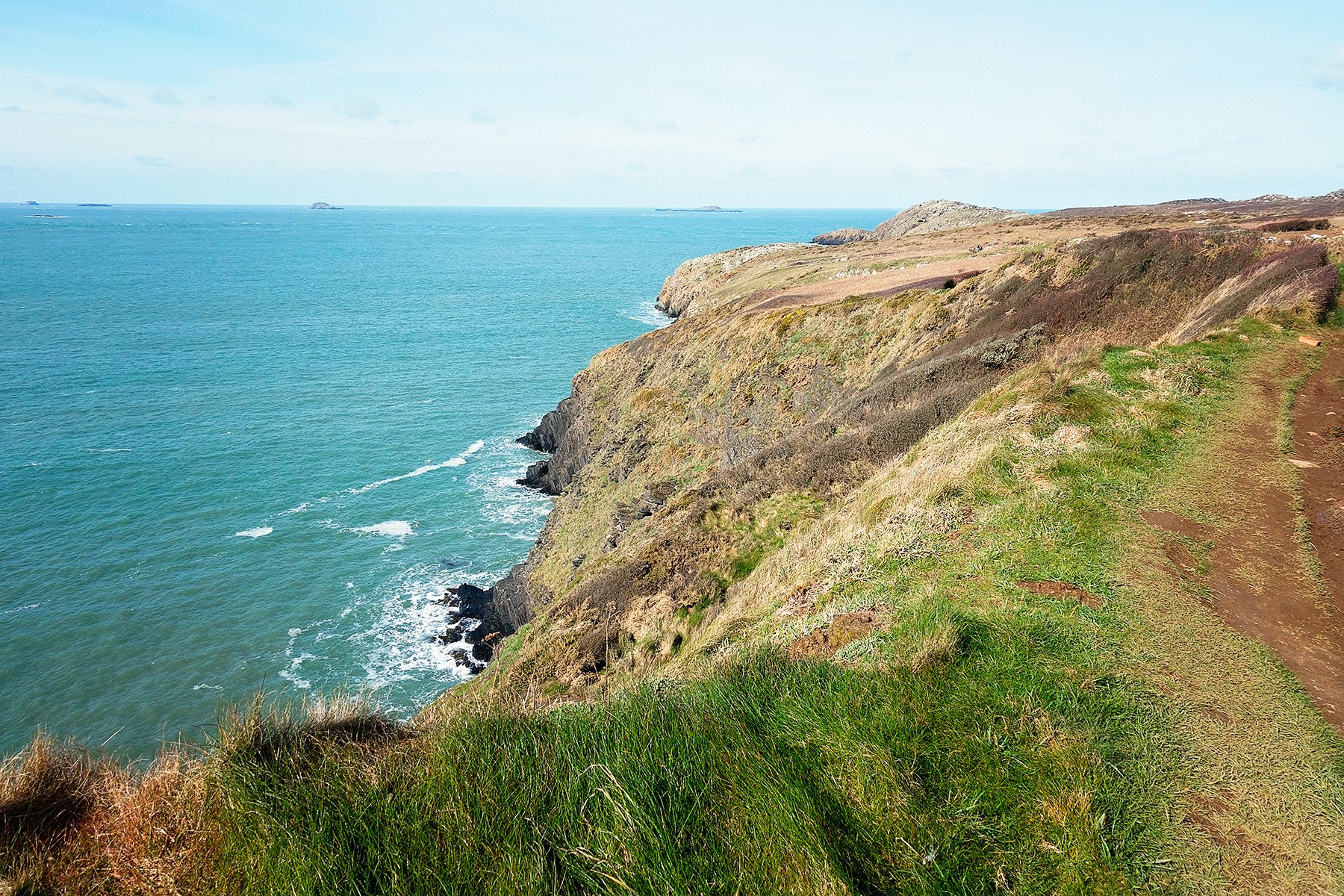
It was such an amazing walk with spectacular far reaching views. I hope we will do it again one day, especially in the heather season in late summer because it must be stunning!


The peak of Pen Beri and the expanse of Cardigan Bay appears in the distance. Two headlands away is the winking lighthouse of Strumble Head with the peak of Garn Fawr above it. ↓


On the plateau a remarkable rockscape opens up. Jagged erratic rocks are mirrored by the rugged profile of Ramsey Island out to sea. North of Ramsey are the ‘Bishops and Clerks’, little islets, one of which is home to a big lighthouse. Offshore, you might be lucky enough to spot porpoises or dolphins playing in the waves.
The area is rich in historical features, such as the neolithic dolmen below, the remains of an ancient tomb where the earth mound heaped up over the stones has eroded away.


I made a 360 degree video from St. David’s Head. It was very windy. I’ve tried to hold the camera as steady as I could!
The City of St. David’s
St. David’s (Ty Ddewi in Welsh) and the surrounding peninsula are situated to the north west of Pembrokeshire, Wales in an area of outstanding natural beauty known as the Pembrokeshire National Park.
The city itself (the smallest in the UK) is vibrant and busy with plenty of independent shops, cafes, pubs and restaurants to keep you occupied. It is technically the size of a small village with a population of around 2000, however city status was originally granted in 16c and the local people are very proud of this.

St. David’s Cathedral
Not one of the grander cathedrals of Britain but probably my favourite. It nestles in its wooded valley so that the visitor looks down on it and the Bishop’s palace when approaching from the city gate.
Like the rich geology of the peninsula itself, many different types of stone can be seen jumbled up in its walls. Likewise architectural features of different ages, from the twelfth century to the modern work in the cloister and refectory, can be seen throughout the cathedral complex.
Having said this the cathedral has been spared from some of the heavy handed restorations of the 19th century, possibly due to its remote location away from fashionable society, though the west front was rebuilt by the architect John Nash in the late 18th century only to be rebuilt again by the architect George Gilbert Scott in the 19th century.

Inside the cathedral the solid and massive arches of the Norman nave contrast with the delicate charm of the 16th century timber roof. The nave floor slopes gently upwards towards the east end, following the lie of the land.
As you move towards the east part of the church you move through history to parts of the building constructed in the gothic styles of the 13th – 15th centuries.

Look out for some carved misericords in the choir. These ‘mercy seats’ are hinged to the back of the choir stalls (the rear timber screen) allowing the monks to surreptitiously sit while ‘standing’ for the long services! They are usually decorated with humorous scenes that probably had a moral meaning or lesson that contemporary onlookers would understand.


St. Davids Bishop’s Palace
The imposing bulk of the Bishop’s palace is an impressive backdrop to the cathedral. Built on an ancient part of the the cathedral site, most of the building dates from the time of bishop Henry de Gower in the 14th century. At the time of the reformation, the building went into into decline and was a ruin by the 17th century.
The palace is now administered by CADW, the historic environment agency of the Welsh Government.
Unfortunately having spent most of the afternoon at the cathedral we got to the palace too late to gain entry so will have to see it on our next visit!

Have you visited the St David’s? Let me know in the comments bellow.
You Might Also Like
Tenby – probably the most iconic seaside town in Wales
A spectacular walk around Dinas Island, Pembrokeshire
Climbing the Carn Ingli and visiting Castell Henllys iron age village, Pembrokeshire


